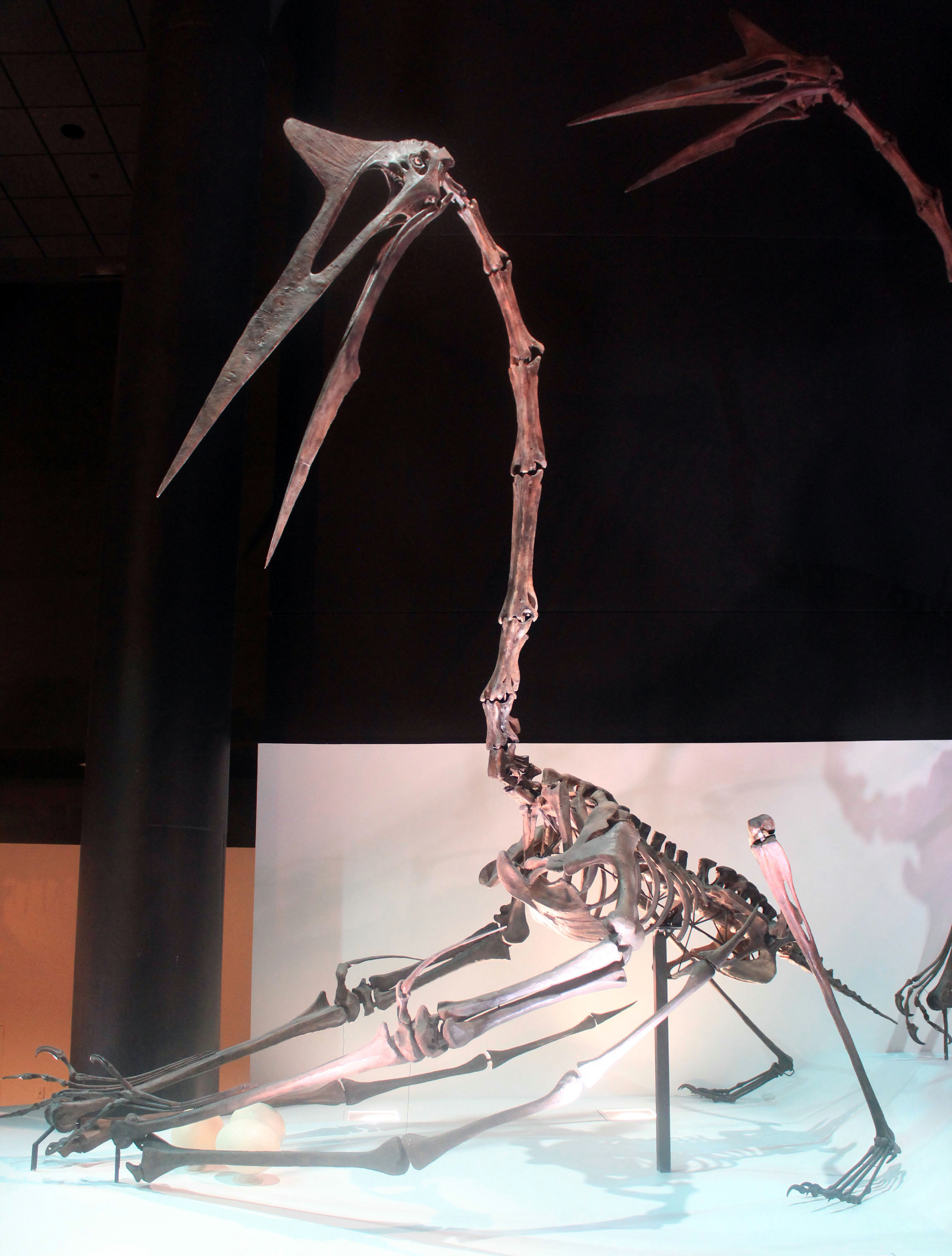
Pterosaurs were lighter than they might appear, due to them having mostly hollow bones and large holes in their skull. For example, Quetzalcoatlus is estimated to have weighed up to 250 kilograms. [7] They had an extremely elongated fourth finger, which supported the entire wing, while the rest of their fingers made up a hand. [5]

Their wings, feet webbing, and tail membranes had muscles and fibres called actinofibrils. These fibres stabilized and strengthened, while also keeping the wings from fluttering and vibrating by contacting and stiffening during flight, allowing pterosaurs to have precise control in the air. [4]
The size of a pterosaur might have affected how they flew, with larger species possibly using air currents to let them soar for long distances while ocassionally flapping their wings. [7]
As pterosaurs evolved, their tails got much smaller, and eventually disappeared. Earlier pterosaurs however, had long tails with a kite shaped membrane at the end. [5] Their tails might have made flight difficult to control and inefficient, this could explain the shape and the presence of actinofibrils, which would have acted similarly to those found in their wings. Another theory is that the tail membrane could have been used for stability, control, and steering in early pterosaurs. [8]
Many species of pterosaurs had head crests of varying shapes and sizes. Some scientists believe these head crests may be helping flight in some way, possibly reducing air resistance. Studies show that a head crest may have been a minimal advantage, though not enough to be the purpose of it. [9]